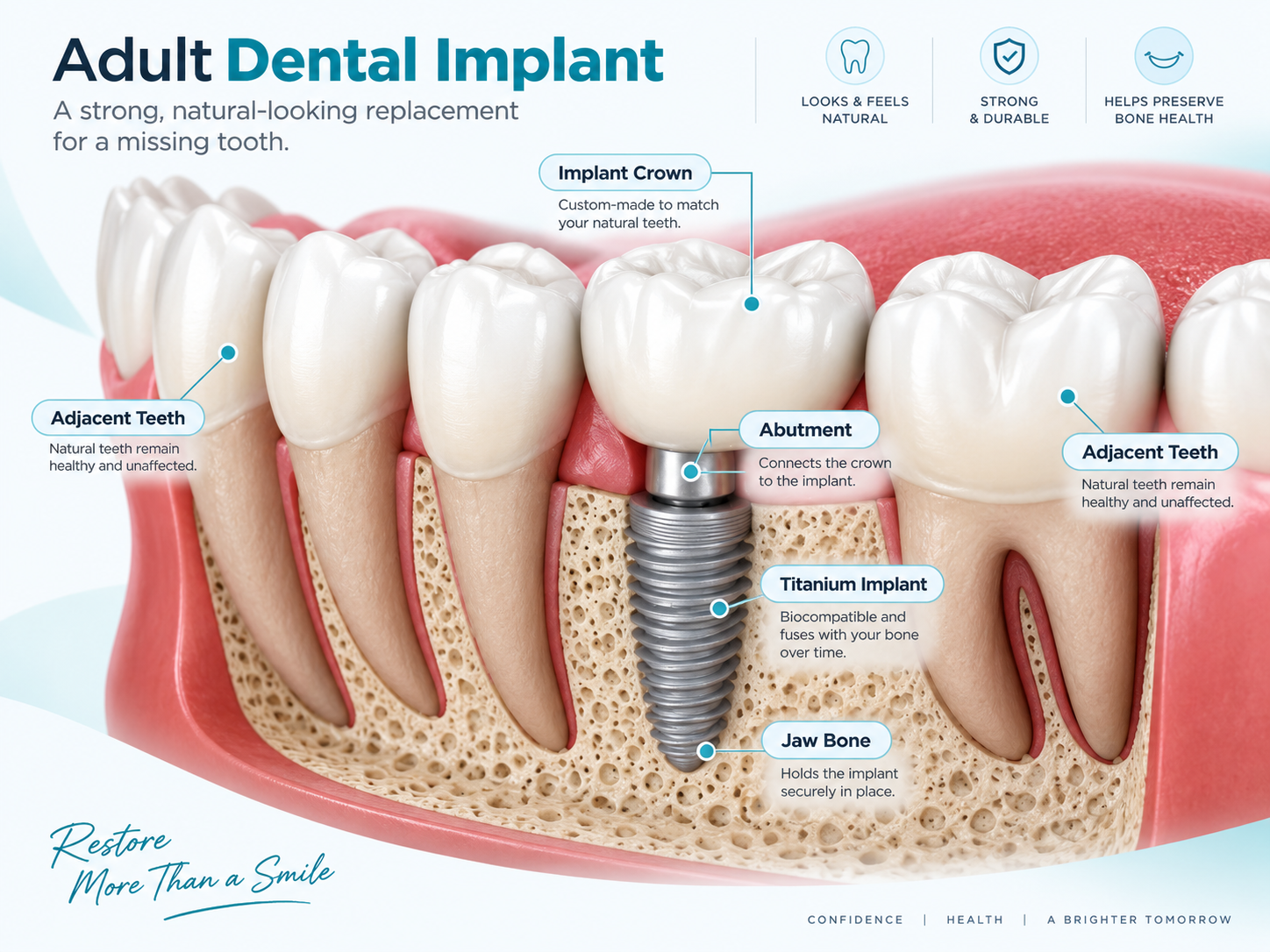
A dental implant is the closest thing modern dentistry has to a natural tooth. Unlike a bridge that relies on neighbouring teeth, or a denture that can be removed, an implant is a permanent titanium post anchored directly into the jaw bone — with a crown on top that looks, functions, and feels exactly like a real tooth. For young patients who have lost a permanent tooth to trauma, decay, or congenital absence, an implant is almost always the best long-term solution. The key constraint: the jaw must stop growing first.
Why Wait Until Jaw Growth Is Complete?
The jaw bone grows continuously through childhood and adolescence. An implant is integrated into bone like a fixed anchor — it does not move or erupt the way natural teeth do. If placed before growth is complete, the surrounding jaw and teeth continue to develop while the implant stays in place, causing the implant to appear to "submerge" over time. In the front of the mouth, this creates a visible step — the implant crown sits lower than the adjacent teeth — that worsens year after year and is expensive and difficult to correct.
This is why the global standard of care is to defer implant placement until skeletal maturity is confirmed. For girls, this is typically around age 17 to 18. For boys, it can be 18 to 21 years. We confirm it with objective radiographic evidence, not age alone.
Waiting does not mean living with a gap. For adolescents who have lost a permanent tooth, we provide:
- Removable partial denture (flipper) — a lightweight acrylic plate with a tooth, worn daily to restore appearance and speech. Most adolescents adapt quickly and peers rarely notice.
- Fixed resin-bonded bridge (Maryland bridge) — a minimally invasive option where a prosthetic tooth is bonded to the backs of adjacent teeth using wings. No drilling. Excellent aesthetics. Can be placed while waiting for implant maturity.
- Space maintainer — if the gap is in a less visible position and aesthetics are not the primary concern, a simple space maintainer keeps the site open for the eventual implant.
What Makes Up a Dental Implant?
Understanding the components helps you ask better questions and make an informed decision:
- Implant fixture (the root) — a screw-shaped titanium post, typically 3.5 to 5 mm in diameter and 8 to 13 mm long, placed surgically into the jaw bone. Titanium is biocompatible; the bone grows around and fuses to it over months in a process called osseointegration.
- Abutment (the connector) — a small component screwed into the top of the implant fixture after healing. It projects above the gum line and forms the foundation for the crown.
- Crown (the visible tooth) — a ceramic or zirconia crown custom-made to match your existing teeth in shape, size, and colour. In India, most implant crowns are zirconia, which offers excellent strength and aesthetics.
The Implant Journey — Step by Step
1. Consultation and Planning
We take a full clinical assessment including an OPG (panoramic X-ray) and, where needed, a 3D CBCT scan to measure bone volume at the implant site. A CBCT scan shows exact bone width, height, and the position of nerves and sinuses — it takes about 10 seconds and is done at our clinic. This allows precise surgical planning and selection of the right implant size.
2. Confirming Jaw Maturity
For patients under 21, we check skeletal maturity before proceeding. A hand-wrist X-ray (to assess growth plate closure) combined with serial dental records (comparing X-rays taken 6 to 12 months apart) confirms that no further growth is occurring. When two consecutive records show no change, we proceed with confidence.
3. Implant Placement Surgery
Implant placement is a minor surgical procedure done under local anaesthesia. A small incision is made in the gum, the implant site is prepared with precision drills, and the titanium implant is placed into the bone. The gum is closed with dissolvable sutures. The whole procedure takes 45 to 90 minutes. Most patients report that it is significantly more comfortable than they expected — discomfort afterwards is usually managed with paracetamol for 1 to 2 days.
4. Osseointegration (Healing Period)
Over the next 3 to 6 months, the bone grows around and fuses to the titanium surface — this is osseointegration. During this time, the patient wears a temporary solution (removable or the Maryland bridge if already in place). At the end of the healing period, stability is verified by a simple manual test before proceeding to the crown.
5. Crown Placement
An impression is taken, and a custom zirconia crown is fabricated in a dental lab. The crown is screwed or cemented onto the abutment. This appointment usually takes 60 to 90 minutes. The result is a permanent, fixed tooth that requires no special maintenance beyond regular brushing, flossing, and periodic check-ups.
What If There Is Not Enough Bone?
When a tooth has been missing for several years, or was lost due to infection, the jaw bone in that area may have resorbed (shrunk). An implant needs a minimum bone width and height to be placed safely. When bone is insufficient, a bone grafting procedure is performed first — typically 4 to 6 months before implant placement.
Bone grafting at our clinic uses either the patient's own bone (harvested from another site in the mouth), a sterile synthetic bone substitute, or a combination. The procedure is done under local anaesthesia and is well-tolerated. Patients in Bengaluru who had their tooth extracted elsewhere and delayed seeking implant treatment often need grafting — this is very manageable and should not delay the decision to start the journey.
Who Is and Is Not a Candidate?
- Good candidates: Patients 18+ with completed jaw growth, good general health, adequate bone volume (or willingness to graft), non-smokers or willing to stop smoking during healing, good oral hygiene.
- Needs careful planning: Patients with diabetes (well-controlled diabetes is compatible with implants; uncontrolled is not), patients on certain medications like bisphosphonates, heavy smokers (smoking impairs healing and significantly increases implant failure risk).
- Not suitable: Active growing patients under 18 (or with confirmed ongoing growth), patients with uncontrolled systemic disease, patients who are unable to maintain oral hygiene.
Implant Aftercare
An implant is a significant investment and caring for it correctly ensures it lasts decades.
- Brushing: Brush gently around the implant crown with a soft-bristled toothbrush. An implant can develop peri-implantitis (gum disease around the implant) if plaque accumulates, similar to how natural teeth get gum disease.
- Flossing: Floss or use an interdental brush around the implant daily. Water flossers (like Waterpik) are particularly effective around implants.
- No biting hard objects: Avoid using the implant crown as a bottle opener, cracking nuts with teeth, or biting pen caps. The crown is strong but not indestructible.
- Regular check-ups: We recommend a check-up every 6 months, including an X-ray annually, to verify the bone level around the implant is stable.
- Night guard if bruxism: Patients who grind their teeth at night should wear a custom night guard — grinding exerts forces on implants that are far beyond what normal chewing produces.
Frequently Asked Questions
Related treatments: