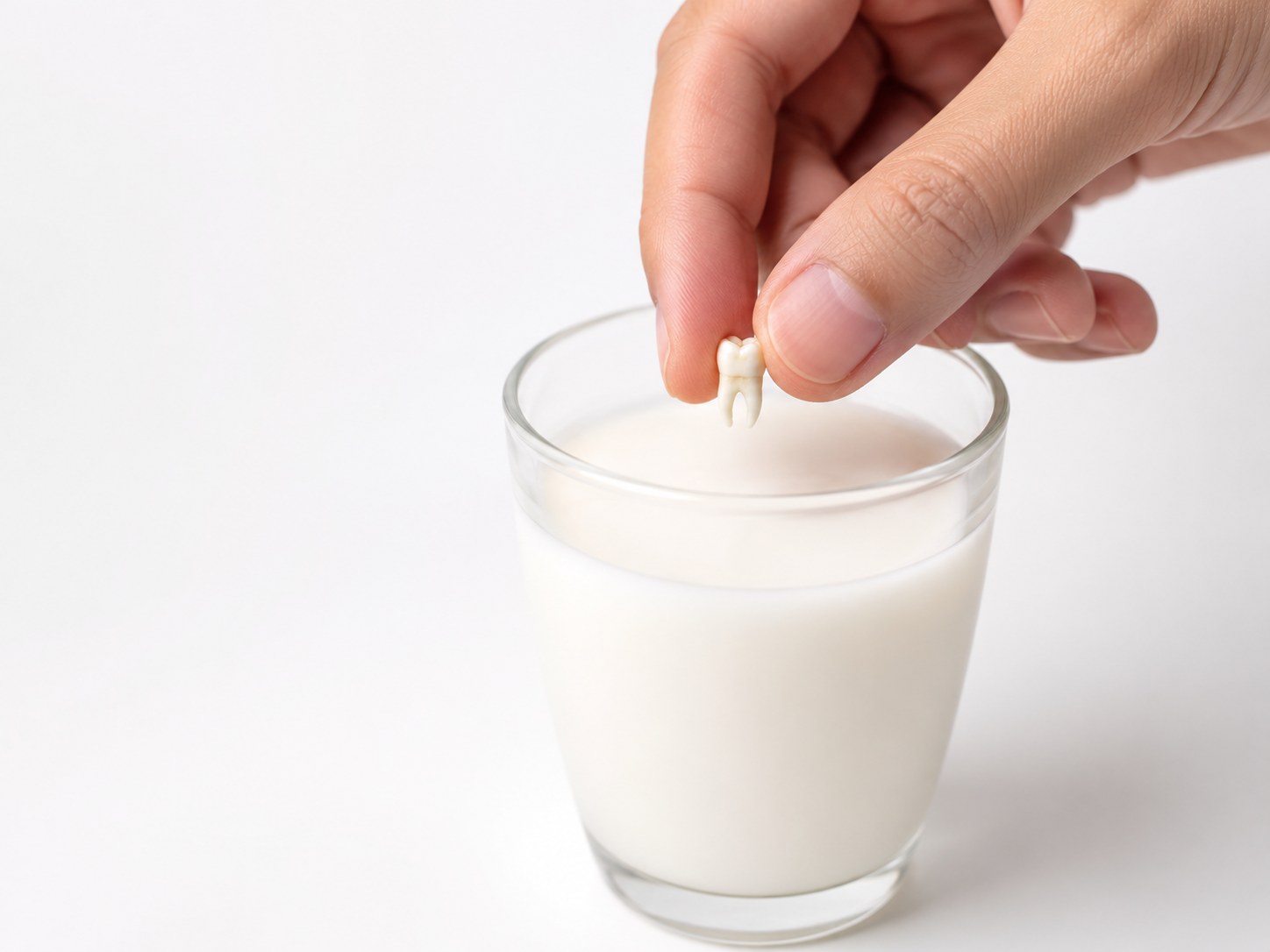
Knocked-out tooth, broken tooth, dental abscess, or uncontrolled bleeding — call us now. Same-day emergency slots are kept available. For knocked-out permanent teeth, the clock starts the moment of injury.
Quick-Action Guide: What to Do Right Now
| Situation | Do This Now | Store / Protect | Do NOT Do |
|---|---|---|---|
| Permanent tooth knocked out | Rinse gently. Try to reimplant. Call us — within 30 minutes is critical. | Milk, saliva, or saline. Never dry. | Scrub the root. Store in water. Wait and see. |
| Baby tooth knocked out | Apply gentle pressure. Keep child calm. Come in same-day. | N/A — do not reimplant baby teeth. | Attempt to put the tooth back. Risk damaging the permanent tooth bud. |
| Broken or chipped tooth | Rinse mouth with warm water. Cold compress to face for swelling. | Save tooth fragments in milk. Bring to clinic. | Leave a sharp edge untreated overnight if a nerve is exposed. |
| Dental abscess / swelling | Call for same-day drainage. Take prescribed antibiotics only. | N/A | Apply heat to the area. Self-medicate with antibiotics without prescription. |
| Soft tissue injury (cut lip/gum) | Press clean cloth firmly for 10 minutes. If bleeding continues, go to hospital A&E. | N/A | Probe or rinse the wound aggressively. |
Dental Emergencies We Treat
Knocked-Out Tooth
Keep the tooth moist in milk or the child's own saliva. Do not scrub or clean it. Call us immediately — re-implantation within 30 minutes has the best prognosis. Do not attempt to reimplant baby teeth.
Broken or Chipped Tooth
Rinse with warm water and apply a cold compress to the face to manage swelling. Save any fragments in milk and come in same-day. A broken tooth with an exposed nerve needs urgent attention to prevent infection and relieve pain.
Dental Abscess
Swelling, intense throbbing pain, fever, or a pimple-like bump on the gum near a tooth is a dental abscess. This is an infection that can spread — it requires same-day drainage and antibiotic cover. Do not apply heat to the area.
Severe Toothache
Pain that is constant, wakes a child at night, or is not relieved by paracetamol suggests pulp involvement. This is not something to watch and wait on — call us for a same-day slot.
Soft Tissue Injury
Cuts or lacerations inside the mouth from falls or trauma. Apply gentle pressure with a clean cloth. If bleeding does not stop within 10 to 15 minutes, or if the wound is deep, proceed to a hospital emergency department.
Lost or Broken Appliance
A broken brace wire, a displaced space maintainer, or a loose orthodontic bracket — call us and bring the appliance in. Loose wires can cause soft tissue injury; space maintainers that fall out need to be re-cemented promptly.
Types of Dental Trauma in Children
Not all tooth injuries are the same. The correct first aid and urgency depend on the type of trauma.
| Type | What It Looks Like | Urgency |
|---|---|---|
| Concussion | Tooth is sensitive and tender but in normal position; no mobility. | Same day |
| Subluxation | Tooth is mobile but not displaced; bleeding from the gum sulcus. | Same day |
| Extrusion | Tooth is partially pulled out of its socket; appears longer. | Emergency — within hours |
| Lateral luxation | Tooth is displaced sideways or backwards; may contact opposing teeth abnormally. | Emergency — within hours |
| Intrusion | Tooth is pushed up into the socket; appears shorter than adjacent teeth. | Emergency — same day |
| Avulsion (knocked out) | Tooth is completely out of the socket. For permanent teeth: 30-minute window for reimplantation. | Critical — call immediately |
Special Needs Dentistry
Children with special needs deserve dental care that meets them where they are. Dr. Mittal has extensive training and 18 years of experience working with children across a wide range of developmental, physical, and cognitive conditions — adapting every element of the appointment to the child's specific sensory and communication needs.
Autism Spectrum Disorder (ASD)
Children with ASD may find the sensory environment of a dental clinic — lights, sounds, smells, physical contact — genuinely distressing. Our protocol:
- Pre-visit social story — a visual guide to what will happen, sent in advance so the child can prepare.
- Reduced sensory input — dimmed overhead lights, minimal staff in the room, no background music.
- Desensitisation visits — the first appointment may involve no treatment at all; simply sitting in the chair, touching instruments, and building familiarity.
- Clear, literal communication — instructions given one step at a time, in direct language. No idioms.
- Choice and control — wherever possible, the child chooses the order of steps or signals for breaks.
- Parent guidance — written notes after every visit on what worked and what to reinforce at home.
Cerebral Palsy
- Positioning — wheelchair transfer or adaptations to the dental chair with support cushions and head rests to ensure safe, comfortable access.
- Involuntary movements — worked around with shorter appointments and frequent breaks rather than resisted.
- High decay risk — children with CP often have altered saliva, dietary issues, and difficulty with oral hygiene; preventive protocols are intensified.
- Communication — for non-verbal children, we establish a clear stop signal (hand raise, foot movement) before any procedure begins.
- Carer coordination — home care instructions are always practical and adapted to the child's motor ability and carer's capacity.
Down Syndrome
- Hypotonia awareness — reduced muscle tone affects mouth breathing, tongue posture, and gum health; we monitor and manage accordingly.
- Periodontal surveillance — children with Down syndrome have elevated gum disease risk; cleaning frequency is adjusted to match.
- Missing or unusual teeth — congenitally absent teeth and delayed eruption are common; we plan and monitor proactively.
- Simple, predictable routines — same sequence each visit; the same staff member where possible; advance phone reminders framed as familiar events.
- Cardiac considerations — a significant proportion of children with Down syndrome have congenital heart conditions; we coordinate with the cardiologist on any antibiotic prophylaxis requirements.
Sensory-Adapted Dentistry
For children with sensory processing differences, anxiety disorders, or any condition that makes standard clinic environments difficult, we offer a sensory-adapted appointment slot: noise-reducing headphones, weighted lap pad, reduced clinical team, pre-scheduled without overlap with other patients, and the option to tour the room before any treatment begins.
Full-Mouth Rehabilitation Under GA
Where dental disease is extensive and cooperation limits cannot be overcome with behavioural management or conscious sedation, comprehensive treatment under general anaesthesia allows all necessary care — extractions, fillings, crowns, pulp treatments — to be completed in a single, safe, controlled session. We coordinate directly with paediatric anaesthesiologists at NABH-accredited hospitals in Bengaluru.
What Parents Say
“My son knocked out his front tooth on a Sunday evening. I called the emergency number and Dr. Mittal’s team guided me to keep the tooth in milk and come in immediately. The tooth was reimplanted and is still there two years later. I cannot thank them enough.”
“Our daughter has ASD and we had tried three other clinics. Dr. Mittal’s team was the first to actually prepare a social story and give us a quiet slot. The desensitisation approach has been transformative for her dental care.”
“My son fell during cricket and cracked a molar. We got a same-day appointment, the tooth was assessed and sealed the same evening. No infection, no pain, no sleepless night. This is what a genuine emergency service looks like.”
Frequently Asked Questions
Related treatments: